
 Eng
EngSponge profile – soft rubber sealing – foam gasket
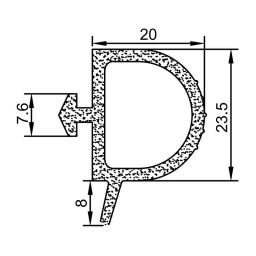
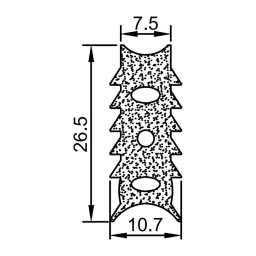
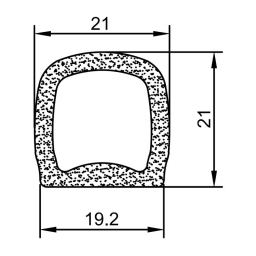
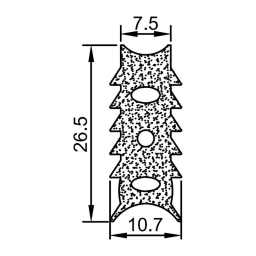
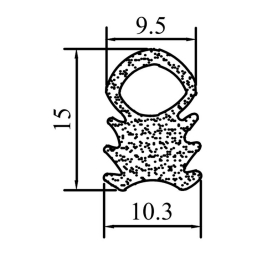
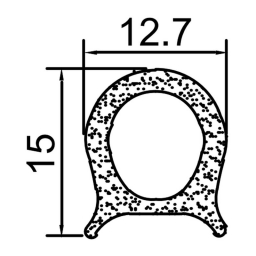
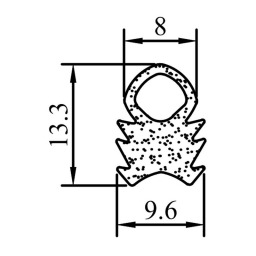
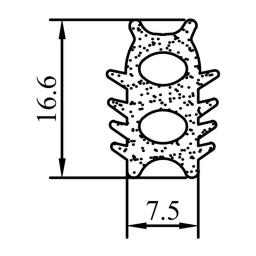
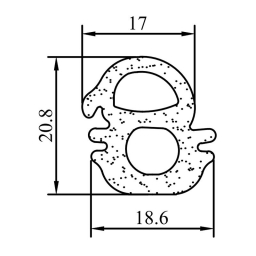
A sponge profile is an elastic material with a closed or semi-open cellular structure, designed for sealing joints and protecting equipment from external influences. Pores make up 20 to 80% of this rubber volume, ranging in size from 0.4 μm to 0.4 mm. Due to its ability to compress and recover its original shape, the porous structure effectively compensates for surface irregularities, ensuring a tight fit for doors, covers, and panels.
The main purpose is to protect industrial cabinets, machines, and mechanisms from adverse environmental factors: dust, moisture, vibrations, and noise, plus sound, thermal, and electrical insulation. Thanks to its strength, elasticity, and long service life, the sponge profile is widely used across various fields.
Industries and applications of the porous seal
Electrical engineering:
- electrical cabinets;
- distribution boards;
- control panels;
- power cabinets.
Telecommunications:
- server cabinets;
- telecom racks;
- outdoor communication cabinets;
- cross-connect cabinets;
- data transmission cabinets.
Power engineering:
- transformer equipment units;
- relay protection cabinets;
- electricity metering boxes;
- instrumentation and control cabinets;
- switchgear.
Mechanical engineering and industrial equipment:
- machine housings;
- operator panels;
- control consoles;
- production line housings;
- equipment protective covers.
Generator and compressor equipment:
- generator housings;
- genset control cabinets;
- power plant containers;
- compressor housings;
- service hatches.
Transport and special machinery:
- special machinery electrical cabinets;
- instrument panels;
- battery boxes;
- control system housings;
- protective metal compartments.
Industrial refrigeration:
- medium-temperature chambers;
- low-temperature chambers;
- freezer chambers and cabinets;
- blast freezers;
- refrigeration units and compressor stations;
- refrigerated containers.
How to choose a sponge profile for an industrial enclosure
The choice depends on several factors.
Material. For most industrial tasks, an EPDM sponge profile is used, offering resistance to moisture, UV, and temperature fluctuations (typically –35℃ to +65℃). It comes in various hardness levels: soft, medium, and hard.
Installation and profile type. Consider the installation method: groove-mounted (installed in a special metal groove), self-adhesive, or overlay (mounted on the door edge). Various configurations are used: rectangular, round (cord), semi-circular (flat base, convex working part), D, P, E, H, U, T, L, П-shaped, and shaped (complex geometry).
Operating conditions. Consider ambient temperature, exposure to oils, chemicals, dust, and precipitation, as this affects material choice. With special additives, the material can be water-resistant, oil and fuel-resistant, heat-resistant, or food-grade.
IP protection requirements. A correctly selected rubber sponge profile helps achieve the required IP ratings and extends equipment life.
Other factors. Consider enclosure design features (sheet thickness, edge geometry), door opening frequency, and expected loads on the seal.
Q&A
- Difference between a groove-mounted seal and a shaped profile?
A groove-mounted seal differs by installation: it is installed in a special groove without glue. A shaped profile is named for its cross-section and selected for specific sealing needs. Thus, one seal can be both groove-mounted and shaped.
- How to select a sponge profile by gap size?
Profile size is chosen based on the gap and required compression. Optimal compression is 25–40% of the original thickness, ensuring reliable sealing without overloading door hinges and locks.
- Best material for outdoor electrical equipment: EPDM, neoprene, or silicone?
-For most outdoor applications, EPDM is optimal, being resistant to UV, moisture, ozone, and temperature changes. Silicone is used for extreme temperatures, while neoprene is for contact with oils and certain chemicals.
- Which IP ratings suit a rubber sponge seal?
- With proper profile and enclosure design, sponge seals achieve IP54 to IP66 and higher. The final rating depends on the seal, enclosure manufacturing quality, doors, and mounting joints.
- Which profiles seal electrical and server cabinets?
Groove-mounted, U-shaped, П-shaped, and rectangular sponge profiles are most common. They ensure tight door fitting and protect against dust, moisture, and vibrations. The choice depends on cabinet design and required IP class.
- Service life of an EPDM seal in industrial conditions?
Typically 10 to 20 years. The material retains elasticity despite prolonged exposure to moisture, UV, and atmospheric factors. But actual lifespan depends on operating conditions and door opening frequency.
Assortment of foam gasket from TM "RZ"
The range includes specialized solutions with complex geometry for sealing doors, hatches, and panels. A key feature is the extended operating temperature range: -35 to +120 °C (standard EPDM profiles max out at +70 °C).
Where to buy a sponge profile wholesale from the manufacturer
Osnova-Market offers sponge profiles wholesale for industrial equipment manufacturers, electrical cabinet assemblers, telecom cabinet producers, and metal enclosure makers.
Our specialists will help select equivalents, determine the optimal sponge profile for your design, and consult on installation and operation. Large customers get regular wholesale deliveries and individual terms.
Planning to buy a sponge profile for mass production or a project? Send an inquiry with your technical requirements. Our managers will calculate the cost and offer the most effective solution.


